
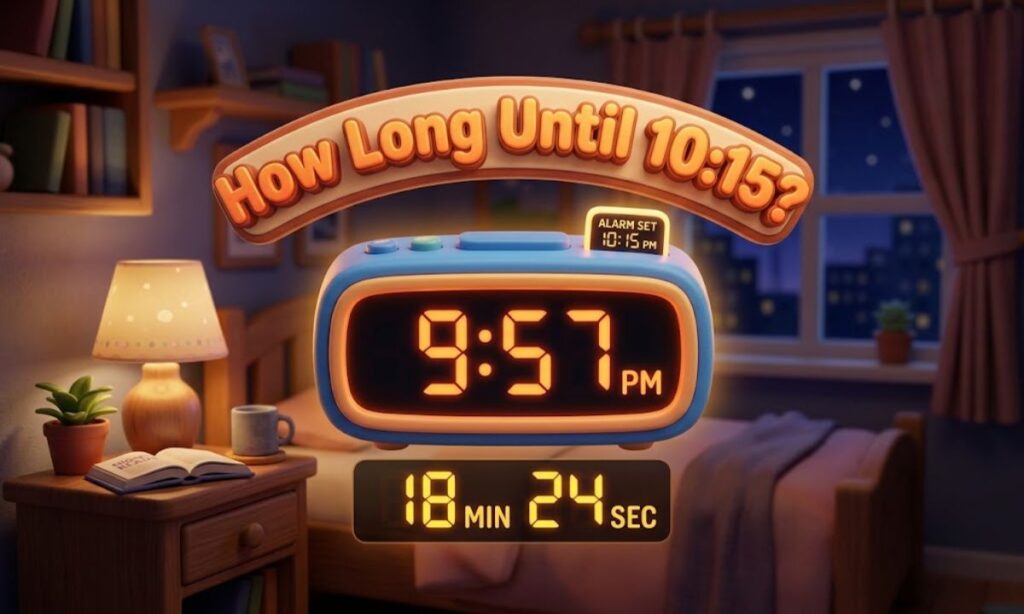
The time left until 10:15 depends on what time it is right now. Subtract the current time from 10:15 and you have your answer. If 10:15 has already passed, you are counting toward 10:15 tomorrow.
This guide shows you how to do that math in your head, gives you a reference table, and covers the time-zone and AM/PM traps that cause most mistakes.
How Long Until 10:15 Right Now?
Your device clock gives the quickest answer. A live countdown timer shows the hours, minutes and seconds remaining until 10:15 and updates every second.
No page can print a fixed answer, because the gap changes every minute. That is why the formula below is more useful than any single number.
Quick rule: The time until 10:15 equals 10:15 minus the current time. If the result is negative, add 24 hours.
Is It 10:15 AM or 10:15 PM?
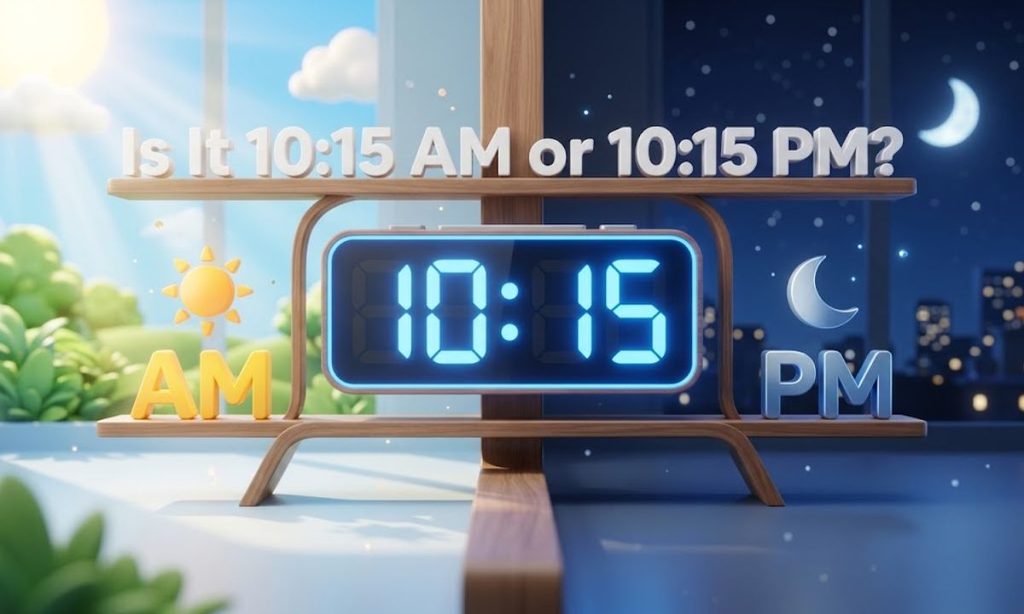
These are two different moments, twelve hours apart. Most confusion starts here.
- 10:15 AM is a morning time. It equals 10:15 on the 24-hour clock.
- 10:15 PM is a nighttime hour. It equals 22:15 on the 24-hour clock, or 2215 in military style.
If you are checking before 10:15 in the morning, the next 10:15 is today’s AM time. If it is already past that point but before 10:15 at night, you are probably counting toward the PM time.
When someone sets a meeting, an alarm or a medication reminder, confirm which one they mean. A twelve-hour mix-up is the most common scheduling error with this particular time.
The Simple Formula for Counting Down to 10:15
You can do this in three steps without a calculator.
- Convert both times to minutes after midnight. Multiply the hours by 60, then add the minutes.
- Subtract the current time from the target. The difference is the minutes remaining.
- Convert back to hours and minutes. Divide by 60 to get the hours, and the remainder is the minutes.
For reference, 10:15 AM is 615 minutes after midnight. That equals 36,900 seconds. 10:15 PM is 1,335 minutes after midnight, or 80,100 seconds.
Worked Example 1: Morning
Suppose it is 7:48 AM.
- Current time: (7 × 60) + 48 = 468 minutes
- Target time: 615 minutes
- Difference: 615 − 468 = 147 minutes
- Result: 2 hours and 27 minutes
Worked Example 2: Evening
Suppose it is 4:40 PM, which is 16:40.
- Current time: (16 × 60) + 40 = 1,000 minutes
- Target time: 1,335 minutes
- Difference: 335 minutes
- Result: 5 hours and 35 minutes until 10:15 PM
Worked Example 3: The Time Has Passed
Suppose it is 11:30 AM and you want the next 10:15 AM.
- Current time: 690 minutes
- Target time: 615 minutes, which is already behind you
- Add 1,440 minutes, the number in a full day: 615 + 1,440 = 2,055
- Difference: 2,055 − 690 = 1,365 minutes
- Result: 22 hours and 45 minutes
Quick-Reference Table: Time Until 10:15 AM
Use this table when you need a fast estimate.
| Current Time | Time Until 10:15 AM |
| 12:00 AM (midnight) | 10 hours 15 minutes |
| 6:00 AM | 4 hours 15 minutes |
| 8:00 AM | 2 hours 15 minutes |
| 9:00 AM | 1 hour 15 minutes |
| 9:30 AM | 45 minutes |
| 10:00 AM | 15 minutes |
| 10:15 AM | Now |
| 10:16 AM | 23 hours 59 minutes (tomorrow) |
Quick-Reference Table: Time Until 10:15 PM

| Current Time | Time Until 10:15 PM |
| 12:00 PM (noon) | 10 hours 15 minutes |
| 3:00 PM | 7 hours 15 minutes |
| 6:00 PM | 4 hours 15 minutes |
| 8:00 PM | 2 hours 15 minutes |
| 9:00 PM | 1 hour 15 minutes |
| 10:00 PM | 15 minutes |
Notice the symmetry. The gap from 12:00 to 10:15 is the same in both tables because AM and PM are exactly twelve hours apart.
A Mental-Math Shortcut: Count to the Next Hour First
You do not always need minutes after midnight. A simpler method is to count in two chunks.
- Find the minutes left until the next full hour.
- Add the whole hours and the final 15 minutes.
Say it is 8:50 AM. That is 10 minutes until 9:00. From 9:00 to 10:15 is 1 hour and 15 minutes. Add them together and you get 1 hour and 25 minutes.
This method works well for short gaps. Most people find it faster than subtraction when the target is under three hours away.
How Time Zones Change the Answer
A clock time only means something inside a specific time zone. A meeting set for 10:15 AM Eastern Time is not 10:15 AM Pacific Time. Pacific is three hours behind Eastern, so the same moment reads 7:15 AM there.
Follow these steps for remote calls or live events:
- Confirm the zone first. Look for labels such as ET, PT, GMT, UTC or a local abbreviation.
- Convert 10:15 to your own zone. Add or subtract the hour difference between the two locations.
- Check daylight saving. Clock changes can shift the offset by an hour for part of the year.
- Use UTC for anything critical. Coordinated Universal Time does not change with the seasons.
Always set your countdown against your own device’s local time, because that is the clock your phone and computer already follow.
10:15 in 24-Hour and Military Time
The 24-hour clock removes the AM and PM ambiguity. Many hospitals, airlines, transit systems and military teams use it for that reason.
| 12-Hour Format | 24-Hour Format | Military Style | Minutes After Midnight |
| 10:15 AM | 10:15 | 1015 | 615 |
| 10:15 PM | 22:15 | 2215 | 1,335 |
In military style, 1015 is read as “ten fifteen.” The time 2215 is read as “twenty-two fifteen.” If you work with schedules across shifts, writing 22:15 prevents the twelve-hour error entirely.
Read More: How Long Until 2:45? A Complete Guide to Calculating Your Countdown
Why People Count Down to 10:15

A specific time on the clock is usually attached to a real task. Here are the situations where this exact minute tends to matter:
- Meetings and classes. A start time of 10:15 is common after a first-period block or a short morning break.
- Medication schedules. A dose at 10:15 PM often marks an evening routine.
- Transit and flights. Departures are listed to the minute, so a few minutes of error can mean a missed connection.
- Sleep planning. People working backward from a 10:15 PM bedtime want to know how much evening is left.
- Online deadlines. Releases, drops and sign-up windows can open at a stated minute.
For anything with a real consequence, set an alarm 10 to 15 minutes early. A buffer is more reliable than perfect arithmetic.
Tools That Do the Math for You
Mental math is useful, but a tool removes the risk of error. These options all work:
- A live countdown page. It shows hours, minutes and seconds remaining and updates in real time.
- Your phone’s timer. Enter the remaining duration and start it.
- A voice assistant. Say “set an alarm for 10:15” and it handles the subtraction.
- A calendar reminder. This is best for recurring events, since it fires at the right time every day.
Common Mistakes to Avoid
Most wrong answers come from a short list of errors.
- Mixing up AM and PM. This creates a 12-hour error.
- Treating minutes like decimals. Ten fifteen is not 10.15 hours. It is 10.25 hours, because 15 minutes is a quarter of an hour.
- Forgetting the day rollover. After 10:15 has passed, the next one is tomorrow.
- Ignoring time zones. A scheduled time in another city needs conversion first.
- Subtracting across the hour carelessly. Borrow 60 minutes, not 100.
Frequently Asked Questions
How long until 10:15?
The time until 10:15 equals 10:15 minus your current time. Use a live countdown or the formula above, and add 24 hours if 10:15 has already passed today.
How many minutes until 10:15 AM?
Subtract your current time in minutes after midnight from 615, which is 10:15 AM in minutes. If the answer is negative, add 1,440 for the next day.
How many hours until 10:15 PM?
Subtract your current time from 22:15 on the 24-hour clock. At 12:00 noon, for example, there are 10 hours and 15 minutes remaining.
What is 10:15 PM in 24-hour time?
10:15 PM is 22:15 in 24-hour time and 2215 in military style. It falls 1,335 minutes after midnight.
What is 10:15 AM in military time?
10:15 AM is 1015 in military time, spoken as “ten fifteen.” It equals 615 minutes after midnight.
How many seconds are in the time until 10:15?
Multiply the minutes remaining by 60. For instance, a 15-minute wait is 900 seconds.
Is 10:15 the same time in every time zone?
No. A clock time is tied to one time zone, so 10:15 AM in New York is a different moment from 10:15 AM in London or Los Angeles.
Conclusion
Working out how long until 10:15 comes down to one subtraction and one question: AM or PM? Convert both times to minutes after midnight, subtract, and add 24 hours if the target has already passed.
Keep the reference tables handy for quick estimates, and use a live countdown or alarm when accuracy matters. For anything time-sensitive, check the time zone and leave a few minutes of buffer.

Henry is a creative writer with 7 years of experience crafting engaging funny name and wordplay-based blogs. He now brings clever humor, fresh creativity, and memorable naming ideas to Fifibullion.com, inspiring readers with unique, catchy, and entertaining names through every piece he writes.