
You glanced at the clock, you’ve got somewhere to be at 2:30, and now your brain wants an exact number. Is it 45 minutes? Two hours? Does it even matter if it’s 2:30 AM or 2:30 PM? This guide walks through exactly how to figure it out, no matter what time it is right now.
Quick Answer
There’s no single fixed answer to “how long until 2:30” because it depends entirely on the current time when you’re asking. The calculation is simple once you know two things: your current time, and whether you mean 2:30 AM or 2:30 PM.
The basic formula is:
Time Until 2:30 = 2:30 (target time) − Current Time
If the result is negative, you’re calculating for the next occurrence of 2:30, so you add 24 hours to the target and try again. That’s really the whole trick. Everything below just walks through it with real examples so you never have to second-guess the math.
READ MORE:https://fifibullion.com/blue-car-names/
Why People Search “How Long Until 2:30”
This is one of those searches that looks oddly specific but makes total sense once you think about it. People type this in because they’re:
- Waiting for a meeting, appointment, or class that starts at 2:30
- Counting down to the end of a work shift or school day
- Timing a nap, a cooking step, or a workout session
- Trying to catch a flight, train, or bus scheduled for 2:30
- Just bored and clock-watching (we’ve all been there)
Google doesn’t always show a live countdown for a query this specific, and manually doing subtraction in your head when you’re tired, distracted, or bad at mental math is annoying. So people search for it instead of just doing the subtraction. Fair enough — that’s exactly what this guide is for.
Step-by-Step: How to Calculate Time Until 2:30
Here’s the process broken into steps so you can apply it no matter what time it is right now.
Step 1: Confirm AM or PM
This sounds obvious, but it trips people up constantly. 2:30 AM and 2:30 PM are twelve hours apart. If you’re not specific about which one you mean, your whole calculation is off by half a day.
Step 2: Convert Everything to 24-Hour Time (Optional but Helpful)
If mental math with AM/PM confuses you, switch to 24-hour format:
- 2:30 AM becomes 02:30
- 2:30 PM becomes 14:30
This removes the ambiguity completely and makes subtraction cleaner.
Step 3: Subtract Current Time From Target Time
Take your current time and subtract it from 2:30 (in whichever format you’re using).
Example: It’s currently 11:15 AM, and you want to know how long until 2:30 PM.
- Convert to 24-hour time: 11:15 becomes 11:15, and 2:30 PM becomes 14:30
- Subtract: 14:30 − 11:15 = 3 hours and 15 minutes
Step 4: Handle the Minutes Carefully
If the minutes in the current time are larger than the minutes in 2:30, you’ll need to borrow an hour, just like traditional subtraction with regrouping.
Example: It’s currently 1:45 PM, and you want to know how long until 2:30 PM.
- 2:30 − 1:45
- Since 45 minutes is more than 30 minutes, borrow an hour from the 2, making it 1 hour and 90 minutes
- 1 hour 90 minutes − 1 hour 45 minutes = 45 minutes
Step 5: If the Target Has Already Passed, Add 24 Hours
If 2:30 already happened earlier today, you’re really asking about tomorrow’s 2:30. Add 24 hours to the target time before subtracting.
Example: It’s currently 6:00 PM, and you want to know how long until 2:30 PM (today’s has passed).
- Next 2:30 PM is tomorrow
- From 6:00 PM today to 2:30 PM tomorrow: 8 hours and 30 minutes
Time Until 2:30 PM: Common Scenarios
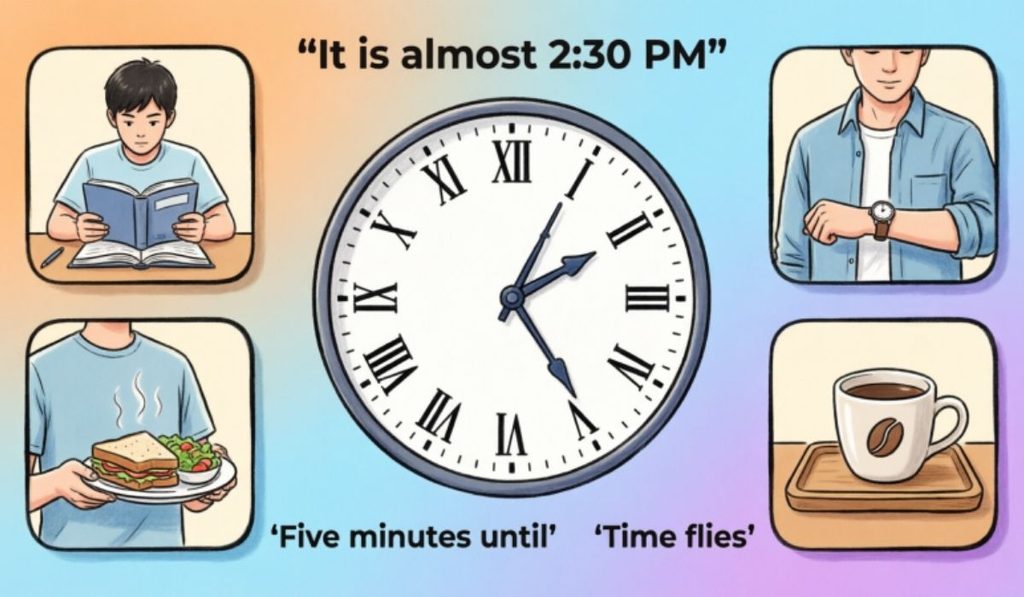
Here’s a table covering typical current times and how far off 2:30 PM would be. Bookmark this if you find yourself doing this calculation often.
| Current Time | Time Until 2:30 PM |
| 8:00 AM | 6 hours 30 minutes |
| 9:45 AM | 4 hours 45 minutes |
| 10:30 AM | 4 hours |
| 11:15 AM | 3 hours 15 minutes |
| 12:00 PM (noon) | 2 hours 30 minutes |
| 1:00 PM | 1 hour 30 minutes |
| 1:45 PM | 45 minutes |
| 2:00 PM | 30 minutes |
| 2:15 PM | 15 minutes |
| 2:29 PM | 1 minute |
| 2:31 PM | 23 hours 59 minutes (next day) |
Time Until 2:30 AM: Common Scenarios
Since 2:30 AM often comes up for night shifts, late flights, or insomnia-fueled clock checking, here’s the same breakdown for the early-morning version.
| Current Time | Time Until 2:30 AM |
| 6:00 PM (prev day) | 8 hours 30 minutes |
| 9:00 PM (prev day) | 5 hours 30 minutes |
| 11:00 PM (prev day) | 3 hours 30 minutes |
| 12:00 AM (midnight) | 2 hours 30 minutes |
| 1:00 AM | 1 hour 30 minutes |
| 2:00 AM | 30 minutes |
| 2:20 AM | 10 minutes |
| 2:35 AM | 23 hours 55 minutes (next day) |
Formula Conversions: Minutes, Decimal Hours, and Seconds
Sometimes “how long” needs to be expressed differently depending on what you’re using it for — a countdown timer, a payroll calculation, or a script. Here’s how a few common gaps convert across formats.
| Time Gap | In Minutes | In Decimal Hours | In Seconds |
| 30 minutes | 30 | 0.5 | 1,800 |
| 45 minutes | 45 | 0.75 | 2,700 |
| 1 hour | 60 | 1.0 | 3,600 |
| 1 hour 15 min | 75 | 1.25 | 4,500 |
| 2 hours 30 min | 150 | 2.5 | 9,000 |
| 3 hours 45 min | 225 | 3.75 | 13,500 |
To convert any hours-and-minutes gap into decimal hours, divide the minutes by 60 and add that to the whole hours. For example, 2 hours 15 minutes = 2 + (15 ÷ 60) = 2.25 hours.
Practical Real-World Examples
Example 1: Catching a 2:30 PM Flight
You’re at home at 11:00 AM and your flight boards at 2:30 PM. That gives you 3 hours 30 minutes. Subtract travel time to the airport, security, and buffer, and you’ll know exactly when to walk out the door.
Example 2: A 2:30 PM Work Meeting
It’s 2:05 PM and your meeting starts at 2:30 PM. You’ve got 25 minutes — enough time to grab coffee, review notes, or finish an email, but not enough to start anything long.
Example 3: Waking Up for a 2:30 AM Shift
You go to bed at 8:00 PM planning to wake for a 2:30 AM shift. That’s 6 hours 30 minutes of potential sleep, assuming you fall asleep right away (which, let’s be honest, rarely happens instantly).
Example 4: A School Bell at 2:30 PM
Class started at 9:00 AM and dismissal is 2:30 PM. Students and teachers alike are counting down 5 hours 30 minutes from the start of the day.
Common Mistakes and Misconceptions
Mixing up AM and PM. This is the single biggest source of wrong answers. Always double-check which 2:30 you mean before doing any subtraction.
Forgetting to borrow an hour. When the current minutes are higher than 30, people often get a negative or confusing number instead of properly regrouping the hour.
Ignoring time zones. If you’re calculating time until 2:30 for an event happening somewhere else, your local clock and the event’s local clock might not match. Always confirm which time zone the 2:30 refers to.
Assuming it’s always the next occurrence. If it’s currently 2:29 PM, the “next” 2:30 is one minute away, not 24 hours away. Always check whether today’s target time has already passed or is still coming up.
Not accounting for daylight saving changes. On the two days a year when clocks shift, your normal math can be off by an hour. If your calculation falls on a clock-change day, add or subtract that extra hour depending on the direction of the shift.
Related Calculations You Might Also Need
If this kind of time math is useful to you, here are a few related calculations worth knowing:
- How long until midnight: useful for New Year’s countdowns or shift calculations
- How many hours between two specific times: the general version of this exact problem
- Time zone conversions: for coordinating meetings or calls across regions
- Countdown to a specific date: for deadlines, birthdays, or events weeks or months away
- Converting minutes to hours and vice versa: handy for payroll, workouts, or cooking timers
Conclusion
Figuring out how long until 2:30 really comes down to one thing: knowing your current time and subtracting it from the target, adjusting for AM or PM and borrowing an hour when needed. Once you’ve got the method down, you can apply it to any target time, not just 2:30.
Whether you’re catching a flight, waiting on a meeting, or just watching the clock tick toward the end of your shift, the math takes seconds once you know the steps.
Frequently Asked Questions
How long until 2:30 PM today?
It depends on the current time. Subtract your current time from 2:30 PM. For example, if it’s noon right now, you have 2 hours 30 minutes left.
How long until 2:30 AM tonight?
Subtract your current time from 2:30 AM, adding 24 hours to the target if it’s already past 2:30 AM today. If it’s currently 11:00 PM, you have 3 hours 30 minutes left.
Is 2:30 considered afternoon or early morning?
2:30 PM is mid-afternoon, while 2:30 AM is very early morning, technically the middle of the night for most people’s sleep schedules.
How do I calculate time until 2:30 without a calculator?
Round the current time to the nearest easy number, subtract in your head using whole hours first, then adjust for the leftover minutes. It’s faster than it sounds once you practice a couple of times.
Does the answer change with daylight saving time?
Yes. On the days clocks spring forward or fall back, add or subtract an hour from your normal calculation, depending on which direction the time change goes that day.

Henry is a creative writer with 7 years of experience crafting engaging funny name and wordplay-based blogs. He now brings clever humor, fresh creativity, and memorable naming ideas to Fifibullion.com, inspiring readers with unique, catchy, and entertaining names through every piece he writes.